Introduction
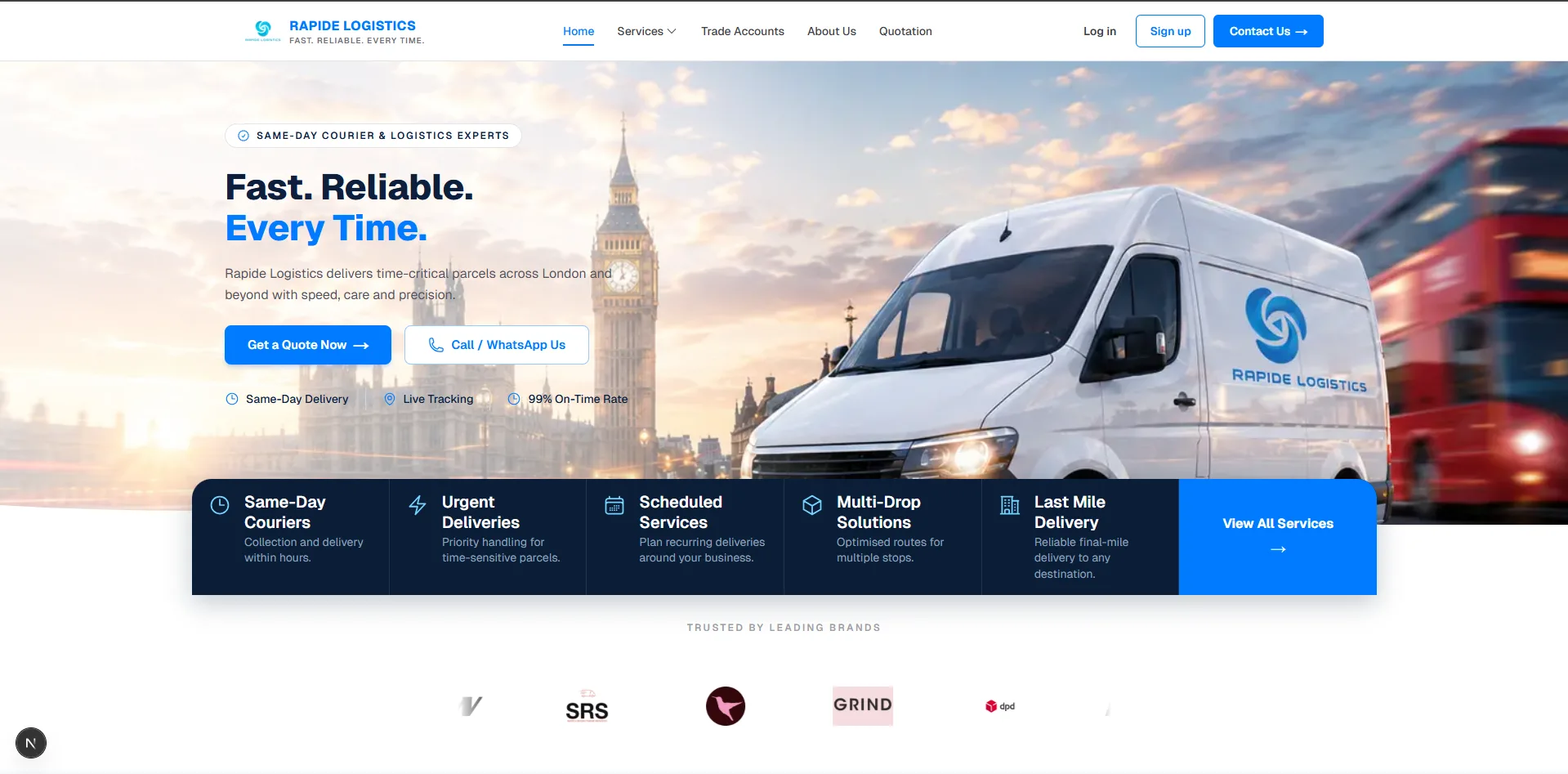
This CodeActivv case study documents how we designed and shipped Rapide Logistics, a United Kingdom logistics operations platform for shipment tracking, client management, billing, and real-time dispatch coordination. UK delivery work is unforgiving: status changes arrive from the road, clients expect proactive updates, and billing must match what actually moved. Rapide Logistics wanted software that respected that operational tempo while making tracking, notifications, and invoicing first-class product experiences rather than afterthoughts buried across WhatsApp, email, and spreadsheets.
Rather than treating the build as a collection of screens, we framed success around durable workflows for dispatchers, operations leads, and client-facing staff. That meant clarifying ownership of consignments and invoices, defining status models early, and choosing a stack — Next.js, TypeScript, MongoDB, Stripe, Socket.IO, OAuth, Docker, and AWS — that the team could extend without rewriting core paths. The live platform is available at https://rapidelogistics.co.uk/.
The narrative below walks through the problem space, requirements, research insights, interface decisions, architecture, integrations, security and performance posture, launch approach, outcomes we can stand behind, and what we would improve next. Where public metrics are not attributable, we describe qualitative outcomes and shipped capabilities instead of inventing vanity numbers or awards.
The client
Rapide Logistics operates in UK logistics and delivery operations, where teams need software that reduces coordination cost without hiding complexity behind empty dashboards. Working with Mr Sadiq, Director, and the Rapide leadership team, CodeActivv prioritized operator adoption: if dispatch and account staff would not trust the system with live consignments, no amount of frontend polish would matter.
CodeActivv partnered as a product engineering team — facilitating discovery workshops, translating constraints into a backlog, prototyping critical journeys, and implementing production-ready services. Communication stayed practical: weekly demos, written decision logs for architectural choices, and explicit trade-offs when timeline pressure collided with scope ambitions.
Stakeholders cared about adoption as much as features. If operators could not complete core tasks faster than their previous process of disconnected tools and inbox follow-ups, the platform would fail regardless of visual quality. That adoption lens shaped every milestone from first wireframe to go-live checklist on rapidelogistics.co.uk.
Business problem
Rapide Logistics was running UK delivery operations across disconnected tools, making it difficult to track shipments, notify clients, and manage billing in one place. When a consignment status changed on the road, the truth often lived in a driver’s message, a spreadsheet cell, and a billing note that did not agree. Clients called for updates that staff had to assemble manually.
The business cost showed up as slow handoffs, duplicated data entry, and inconsistent customer communication. Leadership needed a system of record that reflected operational truth in near real time while remaining understandable for non-technical staff during peak delivery windows.
CodeActivv framed the problem as a product opportunity: replace fragmented tools with a coherent logistics command center, then layer integrations only where they create leverage. We explicitly rejected building every possible module on day one in favor of a resilient core for tracking, notifications, billing, and multi-user access that could absorb future workflows.
- • Reduce manual reconciliation across tools and channels
- • Create a trustworthy shipment and billing status model
- • Support secure access for operations and client-facing roles
- • Ship a maintainable foundation for logistics growth
Requirements & success criteria
Requirements were written as outcomes, not a wishlist of widgets. Primary journeys for dispatchers and account staff had to be completable without tribal knowledge, and administrators needed visibility into exceptions without drowning in noise from every minor status change.
Non-functional requirements covered authentication via OAuth, authorization boundaries between operational roles, responsive performance on common devices, Stripe payment reliability, Socket.IO live updates, and deployment practices compatible with iterative releases on AWS with Docker. We also required observability hooks so production issues could be diagnosed without guessing.
Success criteria aligned with the results later shipped for Rapide Logistics: a unified UK logistics command center; automated client shipment notifications; and a secure multi-user operations portal. Anything that did not support those outcomes was deferred with a documented rationale rather than silently accumulating scope.
- • Documented user journeys and acceptance criteria per milestone
- • Role-aware access and safe defaults for sensitive actions
- • Integration contracts for Stripe, OAuth, and Socket.IO channels
- • Launch checklist covering backups, monitoring, and rollback
Discovery & research
Discovery mixed stakeholder interviews, process walkthroughs, and reviews of logistics patterns appropriate to UK delivery operations. We mapped consignment intake, dispatch assignment, status progression, client notification, and billing closure. Interviews highlighted language clarity, trust signals for commercial clients, and mobile-friendly status checks during busy depot days.
We captured pain points as scenario maps: happy paths, exception paths, and recovery paths when a delivery stalls, a POD is delayed, or billing assumptions change. That research prevented a common failure mode — designing only for the ideal delivery day and discovering edge cases after operators were already live.
Findings were converted into prioritized backlog items with clear owners. Where stakeholders disagreed on notification timing or billing sequencing, we used lightweight prototypes to test assumptions instead of debating abstract preference. Research artifacts remained living documents referenced during design and engineering reviews.
UI design
UI design for Rapide Logistics emphasized clarity, hierarchy, and calm density suitable for commercial dispatch work. We used a restrained professional palette, strong typographic hierarchy, and components that stay readable when users are comparing consignments or confirming billing details under time pressure.
Layouts were designed mobile-aware from the start, even when many operators often work on desktop. Critical actions — update a status, notify a client, open a live feed — remain reachable without hunting through nested menus, and empty states teach the next step instead of showing a blank void.
Visual system decisions favored reuse: shared form patterns, consistent table treatments for shipments and invoices, and status chips with accessible contrast. Tailwind CSS helped the team iterate quickly while keeping spacing and type scales coherent across the operations surfaces on rapidelogistics.co.uk.
UX decisions
UX decisions focused on reducing cognitive load for dispatchers and client account managers. We sequenced multi-step flows so each screen asks for one coherent decision, surface validation early, and make irreversible or financial actions require confirmation.
Status language was standardized so the product and human communication use the same vocabulary for shipment and billing states. Socket.IO-powered live updates highlight what changed and what the user should do next, rather than broadcasting raw system events that create noise on the ops floor.
We also designed for trust: transparent Stripe payment states, clear ownership of consignment records, and recovery paths when something fails mid-update. Accessibility basics — focus order, labels, and readable contrast — were treated as part of UX quality, not a late audit checkbox.
- • Progressive disclosure for advanced operations settings
- • Consistent status vocabulary across UI and live notifications
- • Confirmations for destructive or financial actions
- • Mobile-friendly reading and action patterns for on-the-go checks
System architecture
Architecture for Rapide Logistics separated presentation, application services, and data persistence so teams could evolve logistics features without spreading logic into every UI component. Real-time concerns were isolated behind Socket.IO channels rather than sprinkled ad hoc across the codebase.
We designed for failure: timeouts, retries where safe for idempotent operations, and user-visible error states that preserve draft work when possible. Environment configuration stayed outside repository secrets, and Docker-based deployment artifacts were reproducible for AWS environments.
CodeActivv delivered a full-stack logistics dashboard with live tracking via Socket.IO, Stripe integration, role-based access, and cloud infrastructure on AWS with Docker. Boundaries between modules were documented so future engineers can extend tracking, notifications, and billing without archaeological digs.
Technology stack
Technology choices were pragmatic: proven tools that fit delivery speed and logistics operational needs. Core technologies included Next.js, Tailwind CSS, MongoDB, TypeScript, Socket.IO, Stripe, Docker, AWS, and OAuth.
Next.js, TypeScript, and MongoDB formed the day-to-day development spine, while Stripe, Socket.IO, OAuth, Docker, and AWS covered payments, realtime coordination, identity, and cloud packaging. We avoided novelty for its own sake; every dependency had to justify operational cost for a UK logistics product.
Type safety, linting, and consistent folder conventions reduced review friction. Shared TypeScript types between client and server contracts reduced integration bugs around shipment and payment payloads. The stack choice also made it realistic for Rapide Logistics to iterate after handover without requiring exotic specialist knowledge for routine changes.
- • Next.js & TypeScript — application framework and type-safe product code
- • MongoDB — flexible document store for consignments, users, and invoices
- • Stripe — checkout and billing for logistics charges
- • Socket.IO — live tracking and dispatch coordination updates
- • OAuth — secure multi-user authentication
- • Docker & AWS — reproducible production packaging and hosting
Backend implementation
Backend work centered on stable APIs, authorization checks close to sensitive logistics operations, and services that encode business rules instead of leaving them only in the UI. For Rapide Logistics, that meant modeling domain events that matter to operators and clients — status transitions, notification fan-out, payment confirmations — and exposing them through predictable endpoints.
Background-friendly patterns were introduced where work should not block a user request, such as client notification after status changes or Stripe-related side effects that must be reconciled carefully. Logging included correlation identifiers so support could trace a user-visible issue to server activity.
CodeActivv kept the backend intentionally clear: modular services, explicit validation, and careful handling of payment and identity mutations that carry real commercial risk. That discipline is what lets the command center absorb new features without collapsing into spaghetti as shipment volume grows.
Database design
MongoDB data modeling followed access patterns discovered in research rather than abstract purity. Collections were shaped around how Rapide Logistics reads and writes during peak delivery moments — consignment lists, status updates, notification history, and billing state checks — with indexes planned for the queries that matter.
We defined ownership fields for role contexts, archival strategies where appropriate, and migration habits that keep production data trustworthy across releases. Sensitive payment-related fields were minimized and protected according to the security model and Stripe’s recommended patterns.
The principle stayed consistent: make the schema explain the business of UK logistics coordination, document invariants around shipment state, and avoid clever structures that only one engineer understands. That clarity supports both day-to-day operations and future logistics modules.
API integrations
Integrations were scoped tightly to outcomes: Stripe for payments, OAuth providers for identity, Socket.IO for realtime channels, and AWS APIs for deployment and operations. Each had to earn its place by reducing manual work or increasing trust in a delivery.
Each integration received an anti-corruption layer: normalize third-party payloads, verify Stripe webhooks where relevant, and isolate vendor-specific quirks from core domain logic. This keeps Rapide Logistics portable if a vendor changes or if the client later swaps providers.
Failure modes were designed explicitly — what users see when a payment provider is slow, how retries work for webhook processing, and how operators reconcile partial successes. Documentation for webhook endpoints and environment variables was part of the delivery package, not an afterthought.
Security considerations
Security for Rapide Logistics started with least privilege: operators and client-facing roles see and mutate only what their role allows. Authentication flows used OAuth practices appropriate to a multi-user operations portal, reducing password-reset chaos while keeping access accountable.
We hardened common web risks — injection surfaces, CSRF considerations for cookie-based flows where applicable, secure headers, and careful handling of secrets across Docker and AWS environments. Server-side validation remained authoritative even when the client offered friendly inline checks.
Operational security included environment separation, restricted production access, and backup awareness for critical logistics data. Security is never finished, so we left a clear backlog of follow-up hardening items rather than implying perfection at launch.
Performance engineering
Performance work targeted perceived speed for dispatchers and account staff: fast first paint on key operations pages, responsive interactions after load, and efficient queries for shipment and invoice list views. We profiled slow paths early instead of waiting for complaints after UK operators went live.
Caching and pagination strategies were applied where datasets could grow. Realtime Socket.IO features were tuned to push meaningful deltas rather than flooding clients with redundant events. Frontend bundles stayed intentional — no decorative weight that does not serve operational tasks.
Performance budgets were pragmatic: protect the journeys that create delivery confidence first — track, notify, bill, and confirm status. When trade-offs appeared, we documented them so future optimization work has a starting map.
SEO & discoverability
SEO and discoverability for Rapide Logistics focused on commercial client trust, service discoverability, and UK market search intent around the live logistics platform. Technical foundations included clean URLs, sensible metadata, fast pages, and crawlable public content on rapidelogistics.co.uk.
For authenticated operations routes, we applied technical hygiene: no accidental indexing of private app surfaces, clear canonical strategy for public pages, and structured content that humans and machines can parse without confusion.
Content strategy stayed honest — pages describe real logistics capabilities without fabricated awards or unverifiable statistics. CodeActivv’s approach is that durable SEO follows useful product surfaces and clear information architecture.
Deployment & operations
Deployment emphasized repeatability with Docker packaging and AWS hosting patterns. Environment configuration was managed outside application code so secrets never lived in the repository and promotions between environments stayed predictable.
Release process included smoke tests for critical journeys — authentication, consignment access, status updates, notifications, and Stripe checkout — plus database migration discipline and a rollback mindset. Monitoring and error reporting were connected so the team could respond with evidence rather than anecdotes.
The live product is available at https://rapidelogistics.co.uk/. Post-launch support covered defect triage and prioritized improvements informed by real operator and client usage, keeping the command center stable while Rapide Logistics operated day to day.
Results & outcomes
Outcomes for Rapide Logistics reflect shipped capability, not invented vanity metrics. The engagement delivered a unified UK logistics command center, automated client shipment notifications, and a secure multi-user operations portal.
Qualitatively, stakeholders gained a coherent system where dispatchers and account staff can complete core delivery work with less tool-switching and clearer status communication. The Next.js, TypeScript, and MongoDB spine — with Stripe, Socket.IO, OAuth, Docker, and AWS — supports iteration without rebuilding foundations.
CodeActivv measures success by whether the client can run and evolve the product after handover. Documentation, demos, and a maintainable codebase were part of the result for Rapide Logistics — not extras bolted on after go-live.
- • Unified UK logistics command center
- • Automated client shipment notifications
- • Secure multi-user operations portal
Lessons learned
Early alignment on shipment and billing status vocabulary saved weeks of UI churn later. When every team uses different words for the same state, logistics interfaces become political. Naming is product work, especially in UK delivery operations.
Integrations need ownership maps: who handles Stripe failures, who reconciles partial writes, and which metrics prove Socket.IO channel health. Treating third parties as magical pipes invites silent production pain.
Finally, shipping a smaller reliable operations core beats a wide fragile surface. Rapide Logistics reinforced that lesson for CodeActivv and for the client stakeholders who now operate rapidelogistics.co.uk as a living logistics platform.
Future improvements
Future work can deepen analytics, refine role-specific workspaces for dispatch versus billing, and expand automation around repetitive notification tasks — without disturbing the stable core. Route optimization and client self-serve portals are only valuable once data quality and permissions are trustworthy; Rapide Logistics was built with that sequence in mind.
Additional warehouse integrations, richer reporting, and further performance tuning remain natural next steps as operations usage grows. Each should be prioritized against real user friction rather than roadmap fashion.
CodeActivv remains available to extend the platform with the same discovery-led process used in the original build: clarify outcomes, design the smallest coherent change, and ship it cleanly for UK logistics operations.
Technologies used
- Next.js
- Tailwind CSS
- MongoDB
- TypeScript
- Socket.IO
- Stripe
- Docker
- AWS
- OAuth
Was this helpful?